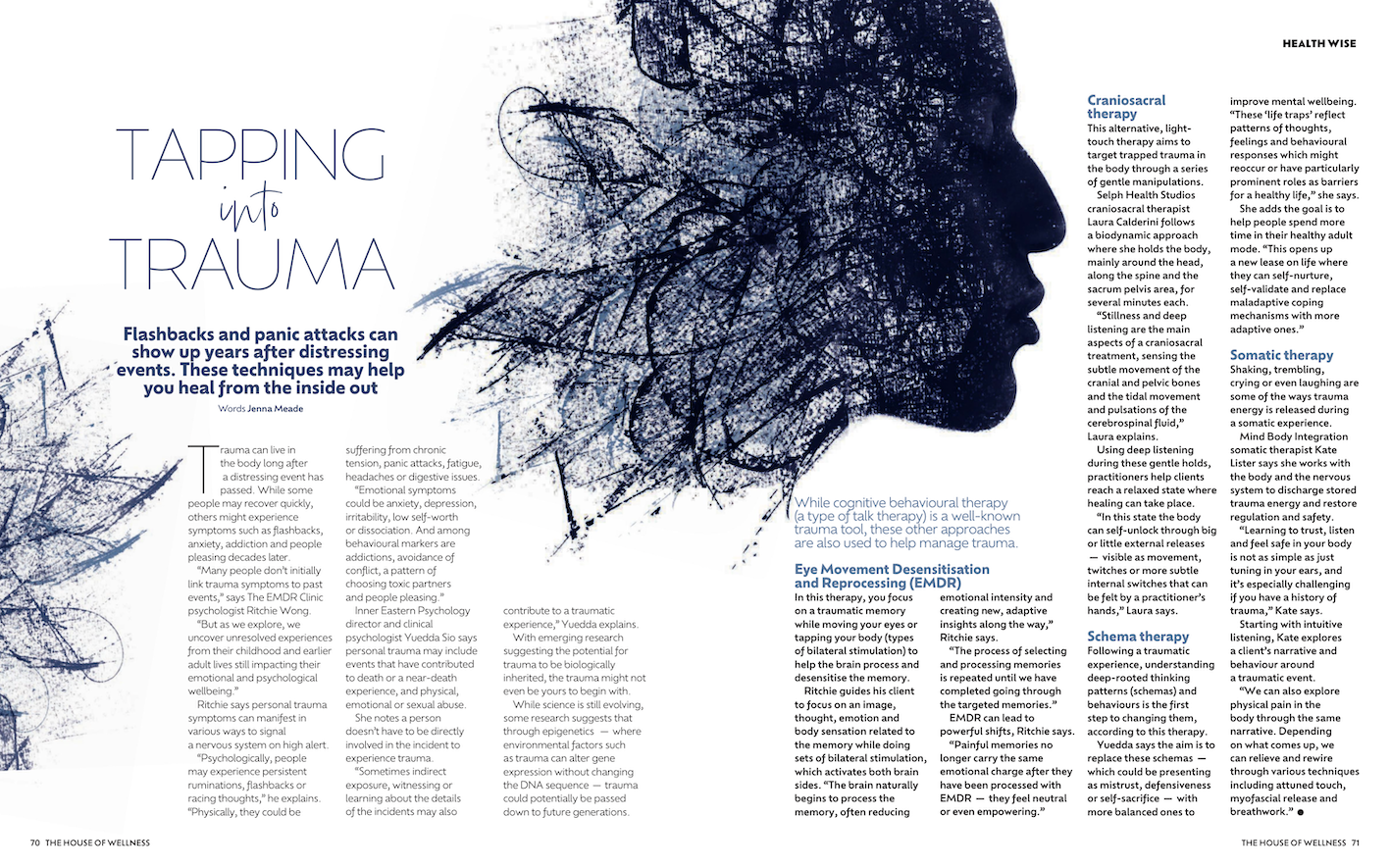
Flashbacks and panic attacks can show up years after distressing events. These techniques may help you heal from the inside out.
Trauma can live in the body long after a distressing event has passed. While some people may recover quickly, others might experience symptoms such as flashbacks, anxiety, addiction and people pleasing decades later.

“Many people don’t initially link trauma symptoms to past events,” says The EMDR Clinic psychologist Ritchie Wong.
“But as we explore, we uncover unresolved experiences from their childhood and earlier adult lives still impacting their emotional and psychological wellbeing.”
Ritchie says personal trauma symptoms can manifest in various ways to signal a nervous system on high alert.
“Psychologically, people may experience persistent ruminations, flashbacks or racing thoughts,” he explains.
“Physically, they could be suffering from chronic tension, panic attacks, fatigue, headaches or digestive issues.
“Emotional symptoms could be anxiety, depression, irritability, low self-worth or dissociation. And among behavioural markers are addictions, avoidance of conflict, a pattern of choosing toxic partners and people pleasing.
Inner Eastern Psychology director and clinical psychologist Yuedda Sio says personal trauma may include events that have contributed to death or a near-death experience, and physical, emotional or sexual abuse.
She notes a person doesn’t have to be directly involved in the incident to experience trauma.
“Sometimes indirect exposure, witnessing or learning about the details of the incidents may also contribute to a traumatic experience,” Yuedda explains.
With emerging research suggesting the potential for trauma to be biologically inherited, the trauma might not even be yours to begin with.

While science is still evolving, some research suggests that through epigenetics – where environmental factors such as trauma can alter gene expression without changing the DNA sequence – trauma could potentially be passed down to future generations.
While cognitive behavioural therapy (a type of talk therapy) is a well-known trauma tool, these other approaches are also used to help manage trauma
Eye Movement Desensitisation and Reprocessing (EMDR)
In this therapy, you focus on a traumatic memory while moving your eyes or tapping your body (types of bilateral stimulation) to help the brain process and desensitise the memory.
Ritchie guides his client to focus on an image, thought, emotion or body sensation related to this memory while doing sets of sets of bilateral stimulation, which activates both brain sides.
“The brain naturally begins to process the memory, often reducing emotional intensity and creating new, adaptive insights along the way,” Ritchie says.
“The process of selecting and processing memories is repeated until we have completed going through the targeted memories.”
EMDR can lead to powerful shifts, Ritchie says.
“Painful memories no longer carry the same emotional charge after they have been processed with EMDR – they feel neutral or even empowering.”
Craniosacral therapy
This alternative, light-touch therapy aims to target trapped trauma in the body through a series of gentle manipulations.
Selph Health Studios craniosacral therapist Laura Calderini follows a biodynamic approach where she holds the body, mainly around the head, along the spine and the sacrum pelvis area, for several minutes each.
“Stillness and deep listening are the main aspects of a craniosacral treatment, sensing the subtle movement of the cranial and pelvic bones and the tidal movement and pulsations of the cerebrospinal fluid,” Laura explains.

Using deep listening during these gentle holds, practitioners help clients reach a relaxed state where healing can take place.
“In this state the body can self-unlock through big or little external releases — visible as movement, twitches or more subtle internal switches that can be felt by a practitioner’s hands,” Laura says.
Schema therapy
Following a traumatic experience, understanding deep-rooted thinking patterns (schemas and behaviours is the first step to changing them, according to this therapy.
Yuedda says the aim is to replace these schemas – which could be presenting as mistrust, defensiveness or self-sacrifice – with more balanced ones to improve mental wellbeing.
“These ‘life traps’ reflect patterns of thoughts, feelings and behavioural responses which might reoccur or have particularly prominent roles as barriers for a healthy life,” she says.
She adds the goal is to help people spend more time in their healthy adult mode. “This opens up a new lease on life where they can self-nurture, self-validate and replace maladaptive coping mechanisms with more adaptive ones.”
Somatic therapy
Shaking, trembling, crying or even laughing are some of the ways trauma energy is released during a somatic experience.
Mind Body Integration somatic therapist Kate Lister says she works with the body and the nervous system to discharge stored trauma energy and restore regulation and safety.
“Learning to trust, listen and feel safe in your body is not as simple as just tuning in your ears, and it’s especially challenging if you have a history of trauma,” Kate says.
Starting with intuitive listening, Kate explores a client’s narrative and behaviour around a traumatic event.
“We can also explore physical pain in the body through the same narrative. Depending on what comes up, we can relieve and rewire through various techniques including attuned touch, myofascial release and breathwork.”