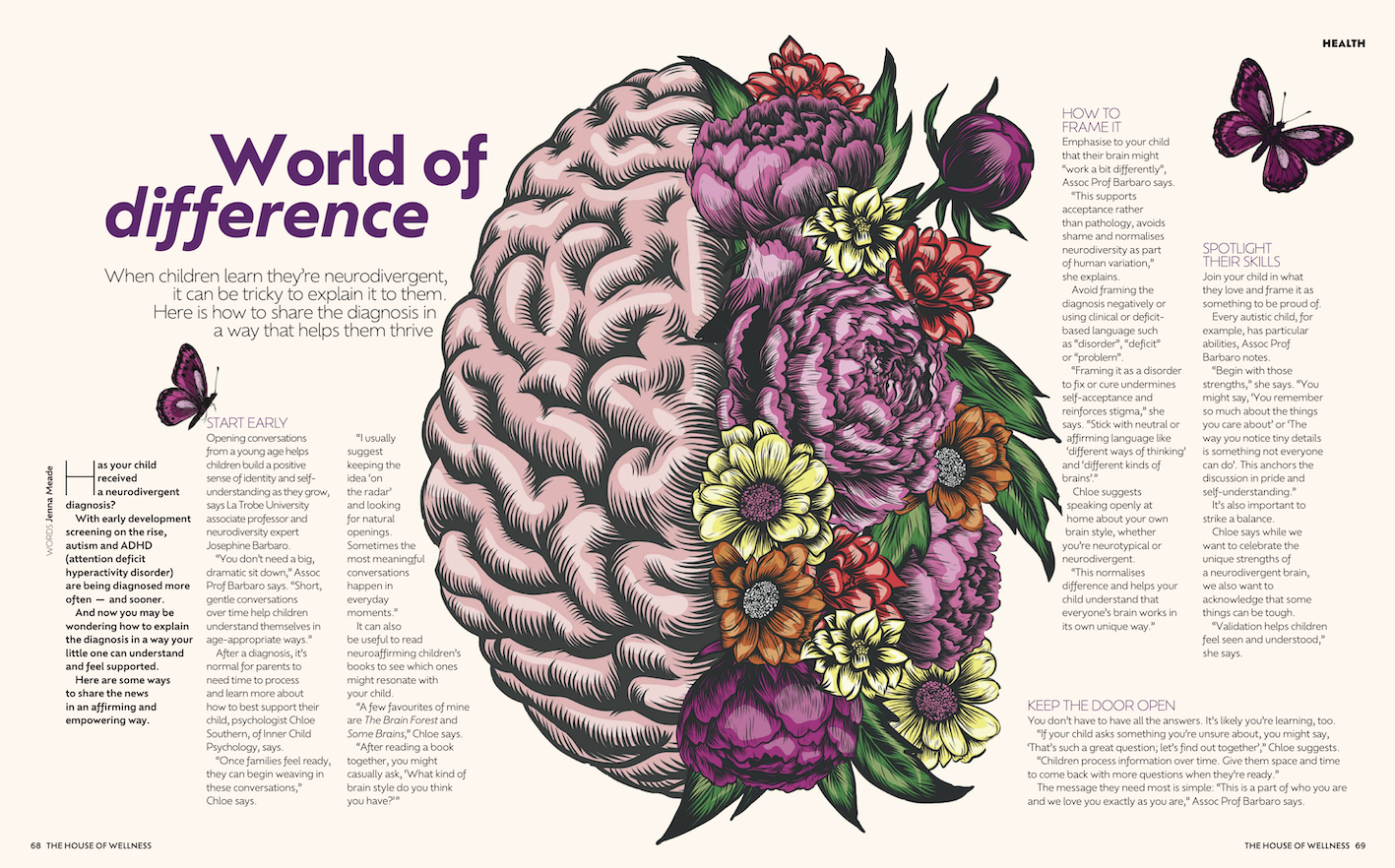
When children learn they’re neurodivergent, it can be tricky to explain it to them. Here is how to share the diagnosis in a way that helps them thrive.
Has your child received a neurodivergent diagnosis?
With early development screening on the rise, autism and ADHD (attention deficit hyperactivity disorder) are being diagnosed more often – and sooner.
And now you may be wondering how to explain the diagnosis in a way your little one can understand and feel supported.
Here are some ways to share the news in an affirming and empowering way.

START EARLY
Opening conversations from a young age helps children build a positive sense of identity and self-understanding as they grow, says La Trobe University associate professor and neurodiversity expert Josephine Barbaro.
“You don’t need a big, dramatic sit down,” Assoc Prof Barbaro says. “Short, gentle conversations over time help children understand themselves in age-appropriate ways.”
After a diagnosis, it’s normal for parents to need time to process and learn more about how to best support their child, psychologist Chloe Southern, of Inner Child Psychology, says.
“Once families feel ready, they can begin weaving in these conversations,” Chloe says.” I usually suggest keeping the idea ‘on the radar and looking for natural openings. Sometimes the most meaningful conversations happen in everyday moments.”
It can also be useful to read neuroaffirming children’s books to see which ones might resonate with your child.
“A few favourites of mine are The Brain Forest and Some Brains,” Chloe says. “After reading a book together, you might casually ask, ‘What kind of brain style do you think you have?'”

HOW TO FRAME IT
Emphasise to your chid that their brain might “work a bit differently”, Assoc Prof Barbaro says.
“This supports acceptance rather than pathology, avoids shame and normalises neurodiversity as part of human variation,” she explains.
Avoid framing the diagnosis negatively or using clinical or deficit-based language such as “disorder”, “deficit” or “problem”.
“Framing it as a disorder to fix or cure undermines self-acceptance and reinforces stigma,” she says. “Stick with neutral or affirming language like “different ways of thinking” and ‘different kinds of brains’.”
Chloe suggests speaking openly at home about your own brain style; whether you’re neurotypical or neurodivergent.
“This normalises difference and helps your child understand that everyone’s brain works in its own unique way,” she says.
SPOTLIGHT THEIR SKILLS
Join your child in what they love and frame it as something to be proud of.
Every autistic child, for example, has particular abilities, Assoc Prof Barbaro notes.
“Begin with those strengths,” she says. “You might say, ‘You remember so much about the things you care about’ or ‘The way you notice tiny details is something not everyone can do’. This anchors the discussion in pride and self-understanding.”

It’s also important to strike a balance. Chloe says while we want to celebrate the unique strengths of a neurodivergent brain, we also want to acknowledge that some things can be tough.
“Validation helps children feel seen and understood,” she says.
KEEP THE DOOR OPEN
You don’t have to have all the answers. It’s likely you’re learning, too.
“If your child asks something you’re unsure about, you might say, ‘That’s such a great question; let’s find out together,” Chloe suggests. “Children process information over time. Give them space and time to come back with more questions when they’re ready.”
The message they need most is simple: “This is a part of who you are and we love you exactly as you are,” Assoc Prof Barbaro says.